


Selling a
Need speed more than the last dollar? See how a cash offer compares to listing in Metro Detroit, with both numbers side by side.
You’ll see national sites quote scarier numbers (10%, even 15%), but those bundle in repairs, moving costs, and worst-case concessions. Below is what a Michigan closing statement actually shows, line by line, with the statute behind every tax and a worked example at each Metro Detroit county’s median price. I’ve sat at a lot of closing tables in Oakland, Macomb, and Wayne counties; this is the kitchen-table version.
How much does it cost to sell a house in Michigan?
Expect roughly 4–8% of the sale price. The floor (~4%) is a seller who pays a 2.5% listing commission and offers no buyer-agent concession. The ceiling (~8%) adds a 3% buyer-agent concession and top-of-range title fees. Transfer tax is fixed by statute at $8.60 per $1,000; everything else is negotiable.
Here’s the full model at three price points that bracket the current county medians of Wayne (~$224K), Macomb (~$284K), and Oakland (~$382K), per Redfin, May 2026:
Table A: What selling costs in Michigan at three price points (2026)
| Line item | $250,000 sale | $400,000 sale | $600,000 sale | Basis |
|---|---|---|---|---|
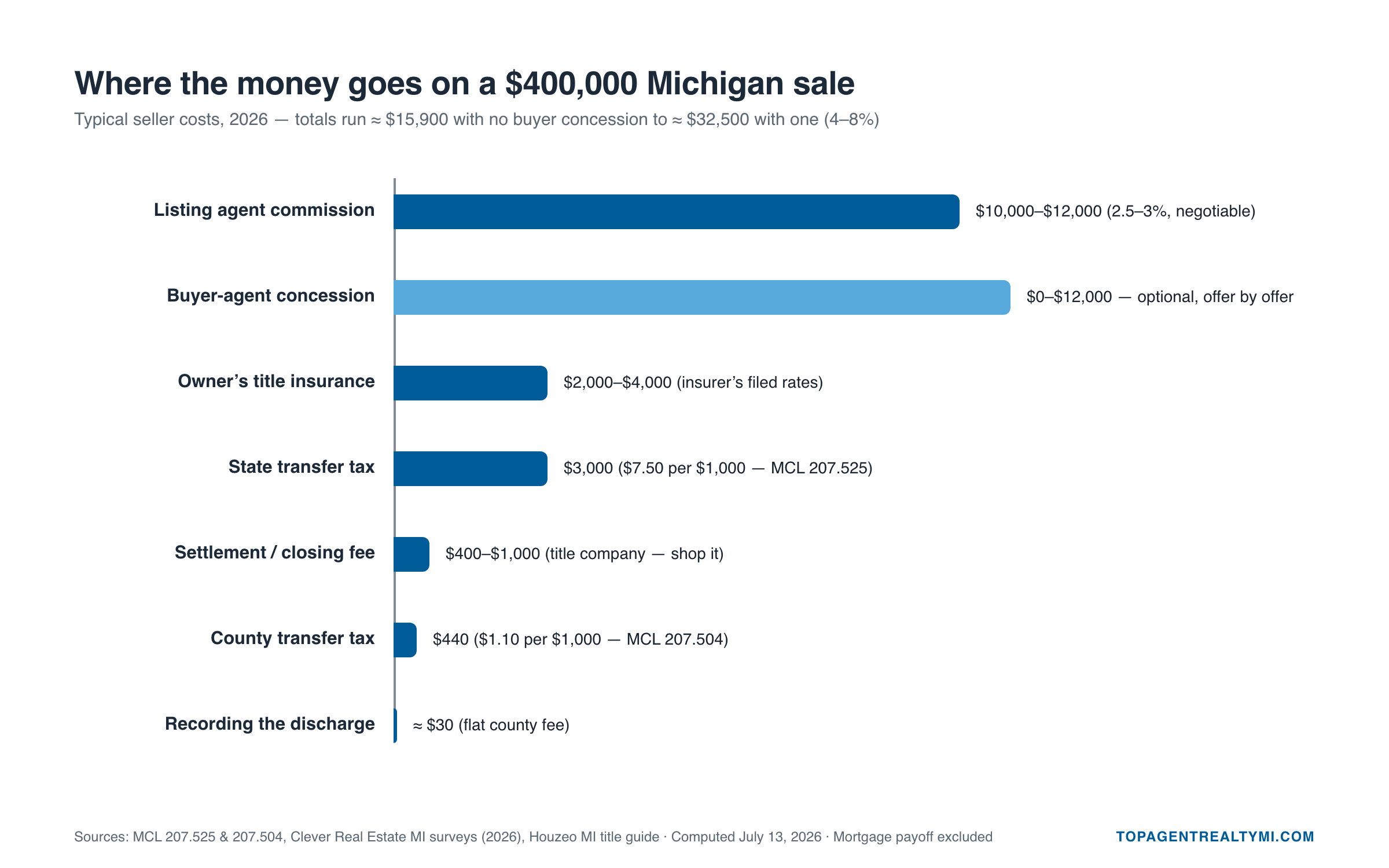
| Listing agent commission (2.5–3%, negotiable) | $6,250–$7,500 | $10,000–$12,000 | $15,000–$18,000 | Clever Feb 2026 MI survey; fully negotiable post-NAR |
| Buyer-agent concession (0–3%, optional) | $0–$7,500 | $0–$12,000 | $0–$18,000 | NAR settlement rules (Aug 2024); Clever reports MI buyer incentives averaging ~2% |
| Michigan state transfer tax ($3.75/$500) | $1,875 | $3,000 | $4,500 | MCL 207.525 |
| County transfer tax ($0.55/$500) | $275 | $440 | $660 | MCL 207.504 |
| Owner’s title insurance (est. 0.5–1% of price) | $1,250–$2,500 | $2,000–$4,000 | $3,000–$6,000 | Houzeo MI rate guide; get an exact quote — filed rates vary by insurer |
| Settlement/closing fee | $400–$1,000 | $400–$1,000 | $400–$1,000 | Houzeo ($400–$600) & Clever ($999 avg) estimates |
| Recording the mortgage discharge | ~$30 | ~$30 | ~$30 | Clever MI closing-cost data |
| Property tax proration | varies by locality & contract | varies | varies | See closing-costs section below |
| Total (no buyer concession) | ≈ $10,100 (4.0%) | ≈ $15,900 (4.0%) | ≈ $23,600 (3.9%) | computed, low end of ranges |
| Total (3% concession, high fees) | ≈ $20,700 (8.3%) | ≈ $32,500 (8.1%) | ≈ $48,200 (8.0%) | computed, high end of ranges |
Source: MCL 207.525 & 207.504 (legislature.mi.gov), Clever Real Estate Michigan closing-cost and commission surveys (updated July 1, 2026 / Feb 2026), Houzeo Michigan title insurance guide. All figures pulled and computed 2026-07-13. Mortgage payoff is excluded; that’s your loan balance, not a selling cost.
One honest caveat: prep work (paint, staging, small repairs) is real money for many sellers, but it ranges from $0 to five figures depending on the house, so no table can price it for you. A good listing agent will tell you which $500 fixes matter and which $5,000 projects won’t return a dime.
What is the average realtor commission in Michigan in 2026?
Michigan agents reported an average total commission of 6.20% in Clever’s February 2026 survey (about 3.09% listing side and 3.11% buyer side), versus 5.70% nationally. But that’s an average of quoted rates, not a rule: since the NAR settlement took effect in August 2024, every commission is negotiable by law, and it must be disclosed in writing.
Two things changed after August 17, 2024, under the NAR settlement:
- Offers of buyer-agent compensation can no longer be posted on the MLS (Realcomp, for most of Metro Detroit). Sellers can still offer compensation off-MLS, or offer concessions toward the buyer’s costs, but nothing is pre-set.
- Buyers must sign written agreements with their agents stating the exact fee and including a “conspicuous statement that broker fees and commissions are fully negotiable and not set by law.”
In practice, Michigan listing commissions in 2026 commonly land between 2.5% and 3%. Sellers are using that leverage: a Redfin-commissioned Ipsos survey (March–April 2025) found 37.4% of recent sellers negotiated or tried to negotiate their agent’s commission. Ask. The worst answer you’ll get is no — and if an agent can’t defend their fee with a marketing plan and net-proceeds math, that tells you something too.
How much is the Michigan transfer tax when selling?
Michigan’s transfer tax is $8.60 per $1,000 of sale price: $7.50 per $1,000 to the state (MCL 207.525) plus $1.10 per $1,000 to your county (MCL 207.504). The seller pays it (MCL 207.523). On a $300,000 sale, that’s $2,580. The tax is collected by the county Register of Deeds when the deed records.
The statutes actually express it per $500: $3.75 state + $0.55 county for each $500 “or fraction of $500,” so the taxable amount rounds up to the next $500 increment. A $284,148 sale is taxed as $284,500. (That recording happens in Pontiac for Oakland County, Mt. Clemens for Macomb, and downtown Detroit for Wayne.)
One wrinkle worth knowing: MCL 207.504 lets counties with more than 2 million residents charge up to $0.75 per $500. No Michigan county qualifies. Wayne, the largest, has about 1.77 million people (U.S. Census Bureau, 2025 estimate), so every county in the state, including Oakland, Macomb, and Wayne, charges the standard $0.55.
Table B: Michigan transfer tax by sale price (seller pays)
| Sale price | State tax ($7.50/$1,000) | County tax ($1.10/$1,000) | Total ($8.60/$1,000) |
|---|---|---|---|
| $150,000 | $1,125 | $165 | $1,290 |
| $200,000 | $1,500 | $220 | $1,720 |
| $250,000 | $1,875 | $275 | $2,150 |
| $300,000 | $2,250 | $330 | $2,580 |
| $350,000 | $2,625 | $385 | $3,010 |
| $400,000 | $3,000 | $440 | $3,440 |
| $450,000 | $3,375 | $495 | $3,870 |
| $500,000 | $3,750 | $550 | $4,300 |
| $550,000 | $4,125 | $605 | $4,730 |
| $600,000 | $4,500 | $660 | $5,160 |
| $650,000 | $4,875 | $715 | $5,590 |
| $700,000 | $5,250 | $770 | $6,020 |
| $750,000 | $5,625 | $825 | $6,450 |
Source: MCL 207.525 (state rate) and MCL 207.504 (county rate), legislature.mi.gov, accessed 2026-07-13. Prices shown are even multiples of $500; odd amounts round up to the next $500 before the rate applies.
Who pays closing costs in Michigan — buyer or seller?
Both pay, but different lines. In Michigan, the seller customarily pays the commission, both transfer taxes (that’s the law for the transfer tax, MCL 207.523), the owner’s title insurance policy, and their share of the settlement fee. The buyer pays lender fees, appraisal, inspection, the lender’s title policy, and their own recording costs.
“Customarily” is doing real work in that sentence: other than the transfer tax, which the statute puts on the seller, almost everything is negotiable in the purchase agreement. In a slow market, sellers get asked to chip in on buyer costs; in a multiple-offer situation, buyers sometimes offer to absorb seller-side items. The contract controls.
What closing costs does a Michigan seller pay besides commission?
Beyond commission, Michigan sellers typically pay 1.5–2.5% of the sale price: the $8.60/$1,000 transfer tax, an owner’s title policy (roughly 0.5–1% of price), a $400–$1,000 settlement fee, about $30 to record the mortgage discharge, and a property tax proration that can go either direction.
Itemized seller closing costs in Michigan (2026)
| Line item | Typical range | Who sets it | Notes |
|---|---|---|---|
| State transfer tax | $7.50 per $1,000 | Statute — MCL 207.525 | Seller pays per MCL 207.523; not negotiable |
| County transfer tax | $1.10 per $1,000 | Statute — MCL 207.504 | All 83 counties charge $0.55/$500 (none exceeds the 2M population threshold) |
| Owner’s title insurance | est. 0.5–1% of sale price (~$1,557 on a $269,500 home per Houzeo) | Insurer’s filed rates | Seller customarily pays in Michigan; rates start ~$4.60/$1,000 on the first $100K |
| Settlement/closing fee | $400–$1,000 | Title company | Houzeo cites $400–$600; Clever’s MI average is $999 — shop it |
| Recording fees (discharge of mortgage) | ~$30 | County | Flat statutory recording fee |
| Mortgage payoff statement / wire fee | Often $0; servicers that charge run under $30, plus a wire fee at closing | Your lender | National figure (Amerisave guide, July 2026); ask for the fee when you request your payoff |
| Property tax proration | Varies — credit or charge | Purchase agreement + local custom | See below; this is Michigan’s biggest closing-statement surprise |
| HOA status letter / transfer fee (condos & HOA subs) | ~$150–$450 for a standard resale package in most markets; rush orders cost more | Your HOA/management co. | National figures (GetHOADocs, Jan 2026); Michigan sets no cap. Required to close if you’re in an association — order it the week you list, not the week you close |
| Buyer-agent concession | 0–3% (negotiated per offer) | You, offer by offer | See next section |
| Staging, paint, repairs | $0 to five figures | You | Optional; spend where your agent shows ROI |
Sources: MCL 207.504/207.523/207.525; Clever (July 2026); Houzeo (title & settlement figures); AnytimeEstimate (title custom); Amerisave (payoff-statement fees); GetHOADocs (resale-package fees). Pulled 2026-07-13.
About that property tax proration, Michigan’s genuine quirk. Michigan bills property taxes twice a year (summer and winter), and whether those bills are treated as covering time already past (arrears) or time ahead (advance) is a matter of local custom and, ultimately, whatever your purchase agreement says. Michigan’s statutory default treats taxes as paid in advance, and that’s the standard convention in Southeast Michigan, meaning a seller who has paid the summer bill typically gets a credit back from the buyer for the portion of the year the buyer will own the home. On a July closing in Royal Oak, the seller has usually just paid the summer bill, so the buyer reimburses them for August through June. In some historically rural areas the custom runs the other way (arrears), which turns that credit into a charge. Same house, same taxes, opposite result — so read the proration paragraph in your listing paperwork, and if you’re moving between regions of the state, don’t assume. (Sources: michiganpropertytax.com proration guide; Iris Mortgage tax-proration explainer; see appendix.)
Do I have to pay the buyer’s agent in 2026?
No. Since August 17, 2024, sellers have no obligation to offer buyer-agent compensation, and such offers can’t appear on the MLS at all. You decide: offer nothing, offer a fixed amount, or respond offer-by-offer. Clever’s July 2026 Michigan data shows sellers still granting buyer incentives averaging about 2% of the sale price.
Here’s the straight version of the trade-off. Most Michigan buyers in 2026 are still represented, and most have signed agreements obligating them to pay their agent something. If you offer nothing, a buyer who owes their agent 2.5% has to bring that cash on top of their down payment, which shrinks your buyer pool or comes back to you as a lower offer or a concession request anyway. If you offer a concession, you keep the pool wide and control the number. On a hot listing in a tight price band you have room to offer little; on a slower listing, the concession is often the cheaper path to a strong net. Run both scenarios with your agent before you list, not after the first offer lands.
Are there Michigan transfer tax exemptions when selling a home?
Yes. The one that matters for ordinary sellers is the principal-residence “SEV exemption” under MCL 207.526(u): if you claimed the Principal Residence Exemption and your State Equalized Value at sale is at or below the SEV when you acquired the home, the state portion ($7.50/$1,000) can be exempt, provided the sale price is an arm’s-length, willing-buyer/willing-seller number.
Your SEV is on your assessment notice (it’s roughly half of the assessor’s view of market value). Compare this year’s SEV to the SEV for the year you bought (for new builds, the first tax day after the certificate of occupancy). In most of Metro Detroit, values have climbed since the mid-2010s, so most 2026 sellers won’t qualify. But if you bought near the 2005–2007 peak or during a local dip and are selling into a flat pocket, check. On a $400,000 sale the state portion is $3,000, so it’s worth five minutes. MCL 207.526 lists 20-plus other exemptions (transfers between spouses, to your own LLC, court-ordered transfers under $100, foreclosures, and more). Note the exemption covers only the state portion ($7.50/$1,000): MCL 207.505, the county act’s exemption list, has no matching provision, so the county’s $1.10/$1,000 is still due. If you paid the tax and later learn you qualified, you can apply to the Michigan Department of Treasury for a refund.
This is one of those items where a sharp title company or agent quietly saves you real money. It’s also not tax advice, so confirm your specific parcel with the title company before relying on it.
How much will I actually net selling in Oakland, Macomb, or Wayne County?
At current county medians of Oakland ~$382,000, Macomb ~$284,148 and Wayne ~$224,327 (Redfin, May 2026), expect selling costs of roughly $9,100–$31,100 depending on county and choices, before your mortgage payoff. Costs scale with price, so the percentage stays near 4% (no concession) to 8% (full concession).
Table C: Estimated cost to sell at each county’s median price (2026)
| County | Median sale price (May 2026, Redfin) | YoY | Est. total cost to sell (low–high) | Est. proceeds before mortgage payoff |
|---|---|---|---|---|
| Oakland | $382,000 (3-mo. avg) | +2.4% | $15,200–$31,100 | $350,900–$366,800 |
| Macomb | $284,148 | +3.3% | $11,400–$23,400 | $260,700–$272,700 |
| Wayne | $224,327 | +4.3% | $9,100–$18,700 | $205,600–$215,200 |
Source: medians from Redfin county housing-market pages, pulled 2026-07-13; cost model from Table A (low = 2.5% listing commission, no buyer concession, low-end title/settlement; high = 3% + 3% concession, high-end fees; transfer tax computed exactly with round-up-to-$500 rule). Your payoff, prorations, and prep costs will move the final number.
Two notes on using this table. First, “proceeds before payoff” is not your check; subtract your remaining mortgage balance. Second, medians move monthly; for the current numbers by county and city, see our Metro Detroit Housing Market Report, which we update every month from Realcomp, Redfin, and FRED data. If you want the actual number for your street rather than your county, start with a free home valuation; the cost model above only gets useful once the price estimate is right.
How can I sell a house in Michigan for less?
Three levers move real money: negotiate the listing commission (37% of sellers already do), decide the buyer-agent concession deliberately instead of defaulting to 3%, and shop the title/settlement fee, where quotes range from $400 to $1,000 for the same work. The transfer tax is the one line you can’t negotiate, unless the SEV exemption applies.
What I’d tell you before you sign a listing agreement:
- Interview more than one agent and ask for a net sheet, not a rate. A 2.5% agent who prices the home wrong costs you far more than the half-point saved. Make every agent show you their pricing logic and marketing plan next to their fee.
- Don’t reflexively offer 3% to the buyer’s side. Look at your price band’s inventory first. Our agents price this decision listing by listing (see real estate agents in Troy, MI), and the answer differs between a $280K ranch in Warren and a $600K colonial in Troy.
- Get two title quotes. Title premiums are filed rates and fairly similar, but settlement fees are not; that’s a phone call worth up to $600.
- Selling FSBO saves the listing commission (2.5–3%) but nothing else. Transfer tax, title, and closing costs remain, most FSBO sellers still end up offering buyer-side compensation, and you take on pricing, disclosure, and negotiation risk yourself. It’s a real option for a hot house and an experienced seller; for most people the math is closer than the ads suggest.
- Spend prep money where it returns. Paint, light fixtures, and deep cleaning routinely pay back; big-ticket remodels before a sale usually don’t.
The levers are the same whether you’re selling a $250K bungalow in Livonia or a $400K colonial in Sterling Heights: the sellers who net the most aren’t the ones who found the cheapest commission — they’re the ones who priced right and negotiated every line on this page.
Frequently asked questions
How much is the transfer tax on a $300,000 house in Michigan?
$2,580: $2,250 to the State of Michigan ($7.50 per $1,000, MCL 207.525) plus $330 to your county ($1.10 per $1,000, MCL 207.504). The seller pays it at recording under MCL 207.523, unless a statutory exemption such as the principal-residence SEV exemption applies.
Is Michigan’s transfer tax deductible?
Not as an itemized deduction. Transfer tax counts as a selling expense, which reduces your amount realized, and therefore any capital gain, under IRS Publication 523 rules. Most primary-residence sellers owe no federal tax anyway thanks to the $250,000/$500,000 home-sale exclusion. Confirm your situation with a CPA.
What is the average realtor commission in Michigan?
Clever’s February 2026 agent survey puts Michigan’s average total commission at 6.20% (about 3.09% listing side and 3.11% buyer side), versus 5.70% nationally. Since the August 2024 NAR settlement, every rate is negotiable and must be disclosed in writing; many Michigan listings close below those averages.
Who pays closing costs in Michigan?
Both sides. Sellers customarily pay the commission, both transfer taxes (required by MCL 207.523), the owner’s title policy, and part of the settlement fee, roughly 4–8% all-in. Buyers pay lender fees, appraisal, inspection, and the lender’s title policy. Nearly everything except the transfer tax is negotiable in the contract.
Can I sell without a realtor in Michigan, and what does it save?
Yes. FSBO is legal and saves the 2.5–3% listing commission. You still owe transfer tax, title, and closing fees (roughly 1.5–2.5%), most FSBO sellers still offer buyer-agent compensation, and you handle pricing, Michigan’s seller disclosure form, and negotiations yourself. The savings are real but smaller than they look.
How much does it cost to sell a $400,000 house in Oakland County?
Roughly $15,900 to $32,500. The fixed piece is $3,440 in transfer tax; the rest depends on your negotiated commission (2.5–3% ≈ $10,000–$12,000), whether you offer a buyer-agent concession (0–3%), and title/settlement fees near $2,400–$5,000. With a typical 2% concession, plan on about $26,000, or 6.5%.
Methodology & sources
Every statutory figure on this page was verified against the Michigan Compiled Laws on legislature.mi.gov on July 13, 2026: the state transfer tax rate of $3.75 per $500 (MCL 207.525), the county rate of $0.55 per $500 with the 2-million-population/$0.75 provision (MCL 207.504), seller liability (MCL 207.523), the principal-residence SEV exemption (MCL 207.526(u)), and the county exemption list (MCL 207.505), which we confirmed contains no county-side analog to the SEV exemption. County population was checked against U.S. Census Bureau estimates to confirm no Michigan county reaches the 2 million threshold. Commission figures come from Clever Real Estate’s February 2026 agent survey (533 agents nationally, 22 in Michigan) and its Michigan seller closing-cost page updated July 1, 2026; negotiation behavior from a Redfin-commissioned Ipsos survey (March–April 2025, per Redfin’s May 16, 2025 release); NAR settlement practice changes from NAR’s official settlement-facts page. Title insurance and settlement-fee ranges are estimates drawn from Houzeo’s and AnytimeEstimate’s published Michigan guides; filed rates vary by insurer, so we label them as estimates and recommend a direct quote. Payoff-statement and HOA resale-package fee ranges are national figures (Amerisave, July 2026; GetHOADocs, January 2026) because Michigan-specific surveys don’t exist; both are labeled as such and set by your lender or association. County median sale prices are from Redfin county housing-market pages (May 2026 data, pulled July 13, 2026). Totals in Tables A and C are our own computations from these inputs; the transfer-tax table applies the statutory round-up-to-$500 rule. This page is reviewed and re-verified quarterly.
About the author
Charles Tamou is the Broker of Top Agent Realty in Troy, Michigan. Top Agent Realty’s 44 agents have closed 3,319+ transactions and more than $1 billion in volume across Metro Detroit, with 1,000+ five-star client reviews. The brokerage serves Oakland, Macomb, and Wayne counties from its office at 1985 W Big Beaver Rd, Troy. Thinking about selling? Start with a free home valuation.
Sources
| Source | What it provided | URL |
|---|---|---|
| MCL 207.525 | State transfer tax rate: $3.75 per $500 of sale price (the $7.50/$1,000 state portion) | https://www.legislature.mi.gov/Laws/MCL?objectName=mcl-207-525 |
| MCL 207.523 | Who owes the transfer tax: the seller or grantor is liable for it | https://www.legislature.mi.gov/Laws/MCL?objectName=mcl-207-523 |
| MCL 207.504 | County transfer tax rate: $0.55 per $500 standard; counties with more than 2 million residents may charge up to $0.75 per $500 | https://www.legislature.mi.gov/Laws/MCL?objectName=mcl-207-504 |
| MCL 207.526 | State transfer tax exemptions; subsection (u) covers the principal-residence SEV exemption | https://www.legislature.mi.gov/Laws/MCL?objectName=mcl-207-526 |
| MCL 207.505 | County transfer tax exemptions (a)-(o); none matches the state’s SEV exemption, so the $0.55/$500 county portion stays due even when the state portion is exempt | https://www.legislature.mi.gov/Laws/MCL?objectName=mcl-207-505 |
| U.S. Census Bureau QuickFacts, Wayne County, MI | Wayne County population is about 1.77 million (2025 estimate), Michigan’s largest county, confirming no Michigan county reaches the 2 million threshold in MCL 207.504 | https://www.census.gov/quickfacts/fact/table/waynecountymichigan/PST045225 |
| Clever Real Estate, “Average Realtor Commission Fees in Michigan: 2026 Survey” (Feb 2026, 22 MI agents) | Michigan average total commission 6.20% (3.09% listing side, 3.11% buyer side) versus 5.70% nationally | https://listwithclever.com/average-real-estate-commission-rate/michigan/ |
| Clever Real Estate, “Seller Closing Costs in Michigan” (updated 2026-07-01) | Non-commission seller costs average 4.08% of price; buyer incentives average 2.00%; transfer taxes 0.86%; title service $999 average; recording $30 average | https://listwithclever.com/real-estate-blog/seller-closing-costs-in-michigan/ |
| National Association of Realtors, “What the NAR Settlement Means for Home Buyers and Sellers” | Effective August 17, 2024: buyer-agent compensation offers can no longer be posted on the MLS; buyers must sign written agreements stating the exact fee; commissions are fully negotiable and not set by law | https://www.nar.realtor/the-facts/what-the-nar-settlement-means-for-home-buyers-and-sellers |
| Redfin, “Real Estate Agent Commissions Haven’t Changed Much Since the NAR Settlement Took Effect” (Redfin-commissioned Ipsos survey, March-April 2025) | 37.4% of recent sellers negotiated or tried to negotiate their agent’s commission | https://www.redfin.com/news/real-estate-commissions-may-2025/ |
| Houzeo, “How Much is Title Insurance in Michigan” | Owner’s title insurance runs about 0.5% to 1.0% of sale price (about $1,557 on a $269,500 home); the seller customarily pays it; settlement fees run $400 to $600 | https://www.houzeo.com/blog/how-much-is-title-insurance-michigan/ |
| AnytimeEstimate, Michigan Title Insurance Rate and Transfer Tax Calculator | Confirms the seller customarily pays the owner’s title policy; Michigan title rates are filed with the state | https://anytimeestimate.com/title-insurance/michigan-title-insurance-calculator/ |
| AmeriSave, “What Is a Mortgage Payoff Statement?” (last updated 2026-07-08) | Payoff statement fees usually run under $30, and many lenders send them free; a separate payoff processing fee can also apply | https://www.amerisave.com/glossary/what-is-a-mortgage-payoff-statement-guide |
| GetHOADocs, “HOA Document Costs Breakdown by Type” (2026-01-29) | Standard resale package runs $150 to $250 in low-cost markets and $250 to $450 mid-range; most states, including Michigan, set no statutory fee cap | https://gethoadocs.com/blog/hoa-document-costs-breakdown |
| MichiganPropertyTax.com, “Prorating Real Estate Taxes in Michigan” | The statutory default is advance proration; advance proration is customary in urban and southeast Michigan, arrears proration in historically rural areas; the purchase contract controls | http://www.michiganpropertytax.com/prorations.htm |
| Iris Mortgage, “How do tax prorations in Michigan affect your closing costs?” | Confirms southeast Michigan transactions are customarily prorated as paid in advance | https://www.irismortgage.com/blog/taxprorations |
| Redfin, Oakland County housing market | Median sale price $382,000 (3 months ending May 2026), up 2.4% year over year | https://www.redfin.com/county/1410/MI/Oakland-County/housing-market |
| Redfin, Macomb County housing market | Median sale price $284,148 (May 2026), up 3.3% year over year | https://www.redfin.com/county/1397/MI/Macomb-County/housing-market |
| Redfin, Wayne County housing market | Median sale price $224,327 (May 2026), up 4.3% year over year | https://www.redfin.com/county/1429/MI/Wayne-County/housing-market |
| IRS Publication 523, Selling Your Home | Selling expenses reduce the amount realized on the sale; the Section 121 home-sale exclusion is $250,000 for a single filer and $500,000 for married filing jointly | https://www.irs.gov/publications/p523 |
| Macomb County Clerk / Register of Deeds, transfer tax page | Confirms the transfer tax is collected at recording | https://www.macombgov.org/departments/clerk-register-deeds/register-deeds/transfer-tax |
What it costs to sell in your city
The model above computed at each city’s own June 2026 median sale price, with local transfer tax and net proceeds: Troy · Birmingham · Royal Oak · Novi · Rochester Hills · Farmington Hills · Sterling Heights · Warren · Livonia · Canton.