

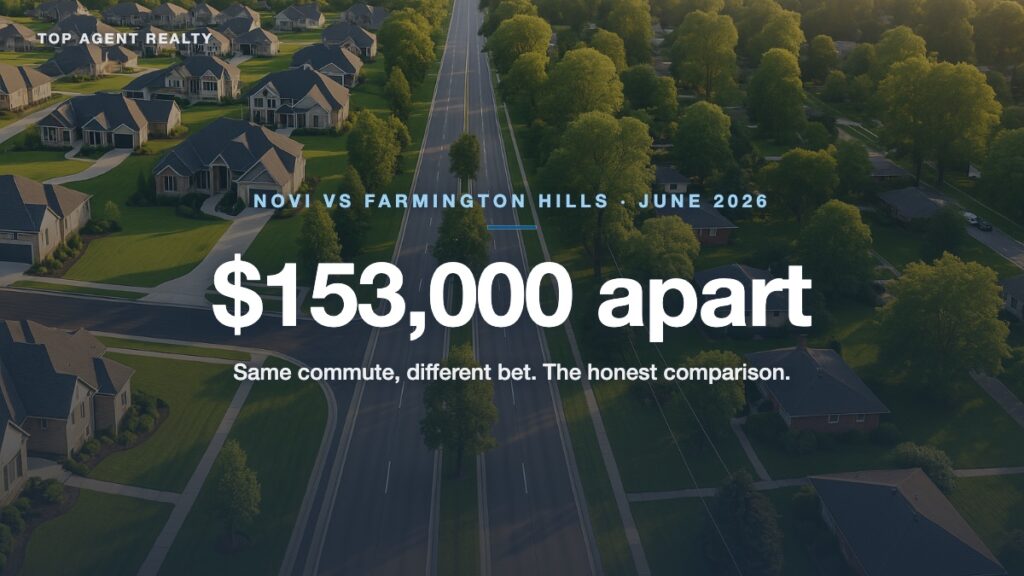
Farmington Hills is the value play: a $395,000 median sale price in June 2026 versus Novi’s $548,000, per Redfin, with a lower median tax bill. Novi answers with Michigan’s #1-ranked school district (Niche, 2026) and one of the metro’s strongest retail and freeway positions. Both cities sell in under a month.
These two Oakland County neighbors sit eight minutes apart on I-696 and show up on the same shortlists, ours included. We sell in both, so this comparison uses the same sourced data we publish in our monthly Metro Detroit housing market report, and where a number can mislead, we say so.
How much does a home cost in Novi vs Farmington Hills in 2026?
In June 2026, Novi’s median sale price was $548,000 against Farmington Hills’ $395,000, per Redfin, a $153,000 gap on closed sales. Typical home values sit closer together: $476,691 in Novi versus $394,714 in Farmington Hills on the Zillow Home Value Index, an $82,000 difference.
Novi vs Farmington Hills by the numbers, June 2026
| Metric | Novi | Farmington Hills |
|---|---|---|
| Median sale price (June 2026) | $548,000 | $395,000 |
| Median price YoY | +12.9% | -4.8% |
| Homes sold (June) | 90 | 97 |
| Median days on market | 25 | 27 |
| Price per square foot | $212 | $176 |
| Zillow Home Value Index (May 2026) | $476,691 | $394,714 |
| ZHVI YoY | +3.2% | +2.8% |
| Population (2020 census) | 66,243 | 83,986 |
Sources: Redfin city market data (all home types, June 2026) and Zillow Home Value Index (smoothed, seasonally adjusted, May 31, 2026 release), both pulled July 13, 2026; U.S. Census Bureau 2020 counts.
Read the two YoY columns carefully, because the single-month swings overstate both stories. Novi’s +12.9% and Farmington Hills’ -4.8% reflect which homes happened to close in June; the smoothed Zillow columns show what typical values are doing, and there the cities are nearly tied at +3.2% and +2.8%. The durable differences are the entry price and the $212 versus $176 per square foot, which means roughly 20% more house per dollar in Farmington Hills. Underlying values are rising at almost the same pace in both.
Which city has better schools, Novi or Farmington Hills?
Novi, by the rankings. Novi Community School District holds an A+ and the #1 spot among Michigan school districts in Niche’s 2026 rankings, and #13 in the nation. Farmington Public Schools, which serves nearly all of Farmington Hills, earns an A- and ranks #53 in Michigan.
Behind the headline grades: Novi’s district reports 71% of students at least proficient in math and 67% in reading on state tests, per Niche. Farmington’s system has real strengths the district grade hides, including Farmington STEAM Academy, an A-rated magnet ranked #18 among Michigan public K-8s, and two A- high schools: Farmington High, #55 in the state with 42% math and 67% reading proficiency, and North Farmington, #65.
Two practical notes before you write an offer over a district ranking. First, check the specific address: most of Novi is in Novi Community Schools, but parts of the city feed Northville, Walled Lake, and South Lyon districts, and district lines do not follow city limits. Second, the school premium is already in the price. Part of that $153,000 gap in the table above is the market paying for the #1 ranking, so a Farmington Hills buyer targeting the STEAM Academy lottery or North Farmington is arguably getting the better school-value trade.
What is the commute like from each city?
Similar, with a slight edge to Farmington Hills. Farmington Hills sits roughly 22 miles from downtown Detroit; Novi is roughly 25. Both plug into I-696 and I-275, and both touch M-5 and Grand River Avenue. Novi adds direct access to I-96 toward Lansing and the west side.
The freeway map is the real story. Novi sits where I-96, I-696, I-275, and M-5 converge, which is why its retail corridor grew where it did and why west-side commuters (Lansing, Brighton, the airport via I-275/I-96) favor it. Farmington Hills is threaded by I-696 with Orchard Lake Road, 12 Mile, Northwestern Highway, and Grand River as its surface arteries, which puts Southfield, Birmingham, and the Woodward corridor a few minutes closer. If your work is east along I-696 or downtown, Farmington Hills shaves the trip; if it is west or you split between both directions, Novi’s interchange cluster is hard to beat.
How do property taxes compare?
Slightly higher in Novi. Novi’s median effective property tax rate is 1.35% with a median annual bill of $5,178; Farmington Hills’ median effective rate is 1.29% with a median bill of $4,296, per Ownwell’s Oakland County data (updated April 2026). Both run above Michigan’s 1.05% state median.
The bill gap ($882 a year at the medians) partly reflects Novi’s higher home values rather than dramatically different rates: at the median effective rates, identical $400,000 homes would differ by roughly $240 a year. Two Michigan-specific cautions apply in both cities. Rates vary within each city by school district and special assessments, so pull the actual millage for the specific address. And under Michigan’s Proposal A, taxable value uncaps to the state equalized value when a home sells, so the current owner’s tax bill on a listing is usually lower than what you will pay in year one. Ask your agent to estimate the post-sale bill, not the seller’s.
What is daily life like in each city?
Novi is Metro Detroit’s retail capital with a growing, newer-built feel: Twelve Oaks Mall with its 180-plus stores, the Suburban Collection Showplace expo center, and Lakeshore Park on Walled Lake. Farmington Hills is larger, greener, and more established, with The Hawk community center, Heritage Park, and walkable downtown Farmington next door.
Novi’s population grew 20% between 2010 and 2020 to 66,243, per the census, and it shows: newer subdivisions, newer commercial strips, and the amenities that follow growth. The trade-off is that much of daily life happens along big suburban corridors built for cars.
Farmington Hills is Oakland County’s second-largest community at 83,986 residents, and it grew up decades earlier, so you get mature trees, varied 1960s-to-1990s housing stock, and more architectural character per block. The city converted the former Harrison High School into The Hawk, a major community and arts center, hosts the Zekelman Holocaust Center, and completely surrounds the smaller city of Farmington, whose downtown supplies the walkable main street Novi lacks. Buyers who choose Farmington Hills over Novi tell us it feels like a neighborhood first and a retail destination second; Novi buyers usually cite the schools and the newer construction.
Which city is the better buy in 2026?
Farmington Hills wins on price: $153,000 less at the June median, about 20% more square footage per dollar, and a lower median tax bill. Novi wins on schools and momentum: the state’s #1 district and slightly faster value growth. At June’s 6.49% average mortgage rate, the payment gap is real money.
Put numbers on it. With 20% down at June 2026’s average 30-year rate of 6.49% (Freddie Mac, via FRED), principal and interest on the median Novi sale runs about $2,768 a month versus about $1,995 in Farmington Hills, a $773 monthly difference before taxes and insurance. That is the honest frame for the decision: Novi asks roughly $9,000 more a year for the #1 school district, newer housing stock, and the I-96 interchange cluster. For buyers without kids in public schools, that premium is hard to justify on the numbers alone. For buyers who would otherwise pay for private school, it can be a bargain.
Both markets move quickly, at 25 and 27 median days on market, so whichever way you lean, walk in with financing arranged. Our Novi agents and Farmington Hills agents work these cities every week, and the Novi and Farmington Hills community pages carry current listings for each. If you already own in one and are weighing a move to the other, start with our breakdown of what selling actually costs in Michigan so the equity math is real before you shop.
FAQ
Is Novi or Farmington Hills more expensive?
Novi. Its June 2026 median sale price was $548,000 versus $395,000 in Farmington Hills, per Redfin, and its typical Zillow home value is $476,691 versus $394,714. Novi also runs higher per square foot, at $212 versus $176.
Which has better schools, Novi or Farmington Hills?
Novi Community School District is ranked the #1 district in Michigan with an A+ grade in Niche’s 2026 rankings. Farmington Public Schools earns an A- and ranks #53 in the state, with standout schools including the A-rated Farmington STEAM Academy. Always verify the district for a specific address.
Are property taxes higher in Novi or Farmington Hills?
Novi’s median effective rate is 1.35% with a $5,178 median annual bill; Farmington Hills’ is 1.29% with a $4,296 median bill, per Ownwell (April 2026). Actual bills vary by school district within each city, and Michigan taxable values uncap when a home sells.
How far are Novi and Farmington Hills from Detroit?
Farmington Hills is roughly 22 miles from downtown Detroit and Novi roughly 25. Both cities connect via I-696 and I-275, and Novi adds direct I-96 access where I-96, I-696, I-275, and M-5 converge.
Is Novi, Michigan a good place to live?
Novi combines Michigan’s #1-ranked school district (Niche 2026), major retail at Twelve Oaks Mall, and a four-freeway interchange, and its population grew 20% from 2010 to 2020. The trade-offs are a higher entry price, at a $548,000 June 2026 median sale price, and a car-oriented layout.
Is Farmington Hills a good place to live?
Farmington Hills is Oakland County’s second-largest community, with an A- school district, mature neighborhoods, The Hawk community center, and downtown Farmington next door. At a $395,000 June 2026 median sale price and $176 per square foot, it is the stronger value of the two cities.
Methodology & sources
All data pulled or checked July 13, 2026 by Top Agent Realty. Sale prices, days on market, homes sold, and price per square foot are Redfin city market data for June 2026, all home types; typical values are the Zillow Home Value Index (mid-tier, smoothed, seasonally adjusted, May 31, 2026 release). School grades, rankings, and proficiency figures are Niche’s 2026 ratings. Tax figures are Ownwell medians for Oakland County cities, updated April 2026; consult the city treasurer for parcel-level millage. Distances and geographic facts follow each city’s published profiles. Monthly payments are principal and interest only, computed at June 2026’s average 30-year fixed rate of 6.49% (Freddie Mac Primary Mortgage Market Survey via FRED, weekly prints averaged) with 20% down, using the standard amortization formula stated in our market report methodology. This is market analysis, not an appraisal of any individual property.
About the author
Charles Tamou, Broker at Top Agent Realty, Troy, MI. Charles leads Top Agent Realty’s 44 agents, who have closed 3,319+ transactions and more than $1 billion in sales volume across Metro Detroit, earning 1,000+ five-star client reviews. Deciding between these two cities? Meet our agents or call the office at 248-277-4226.